Team statistics: the season behind every fixture
Click any team name to open its season: league position, goals for and against, when it scores and concedes, squad ratings, goal lines, fixtures and team news. What each number is good for.
Match Terminal6 min read
The statistics on a match page describe one fixture. Sometimes that isn't the question you have — you want to know what a club has actually been doing all season before you decide anything about Saturday. Every team name on Match Terminal is a link to that, and this guide covers what's on the other side of it.
Getting there: click the team
On a match page, the crest and the name in the header are both links to that club's page.
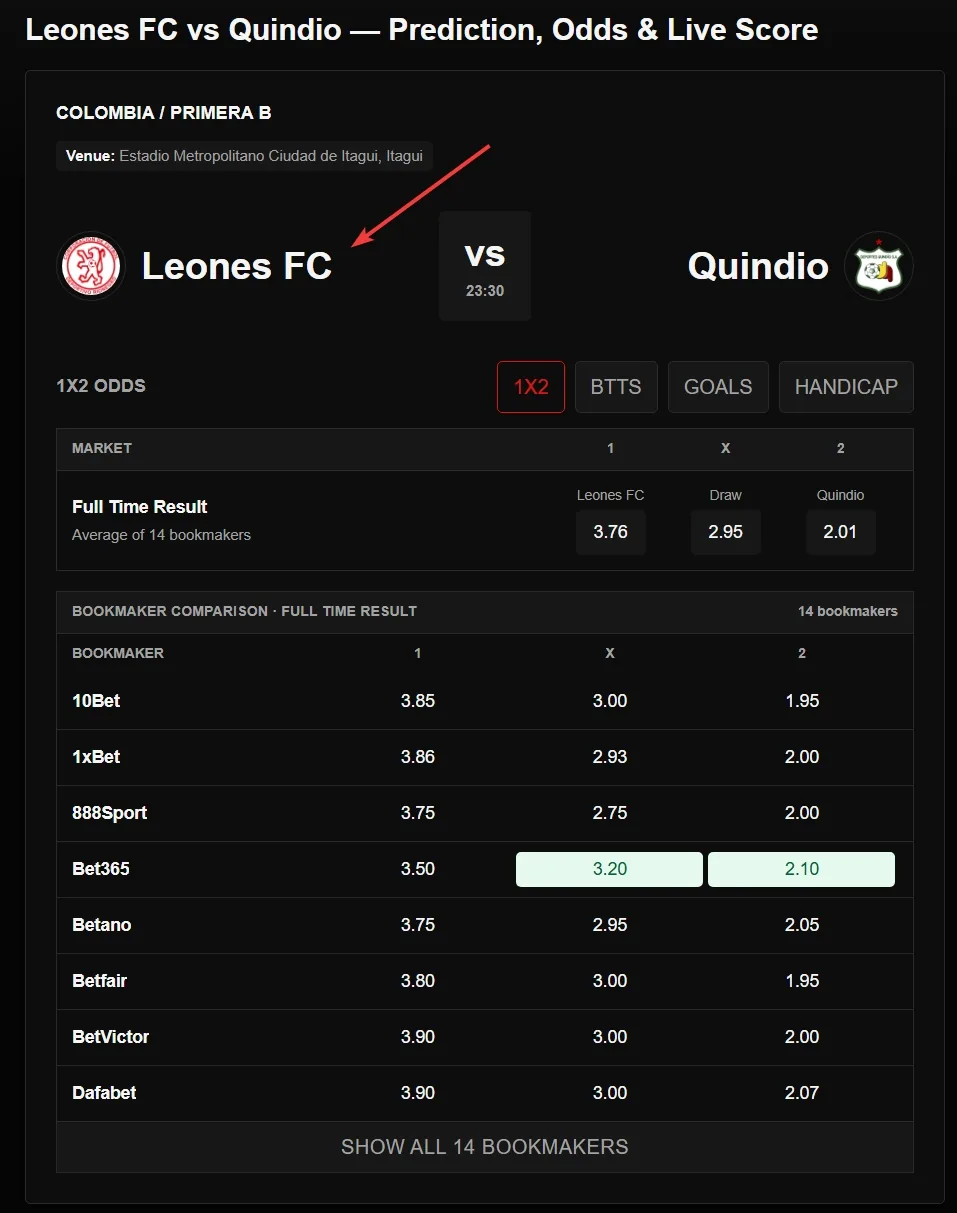
The same is true almost everywhere a team appears: the league standings further down the match page, the table on any league page, and the fixture lists on the home page. If you can see a club's name, you can usually click through to its season.
What's on a team page
The page covers the club's current season in its league: how it has performed, who has played, when it scores, and what's coming up.
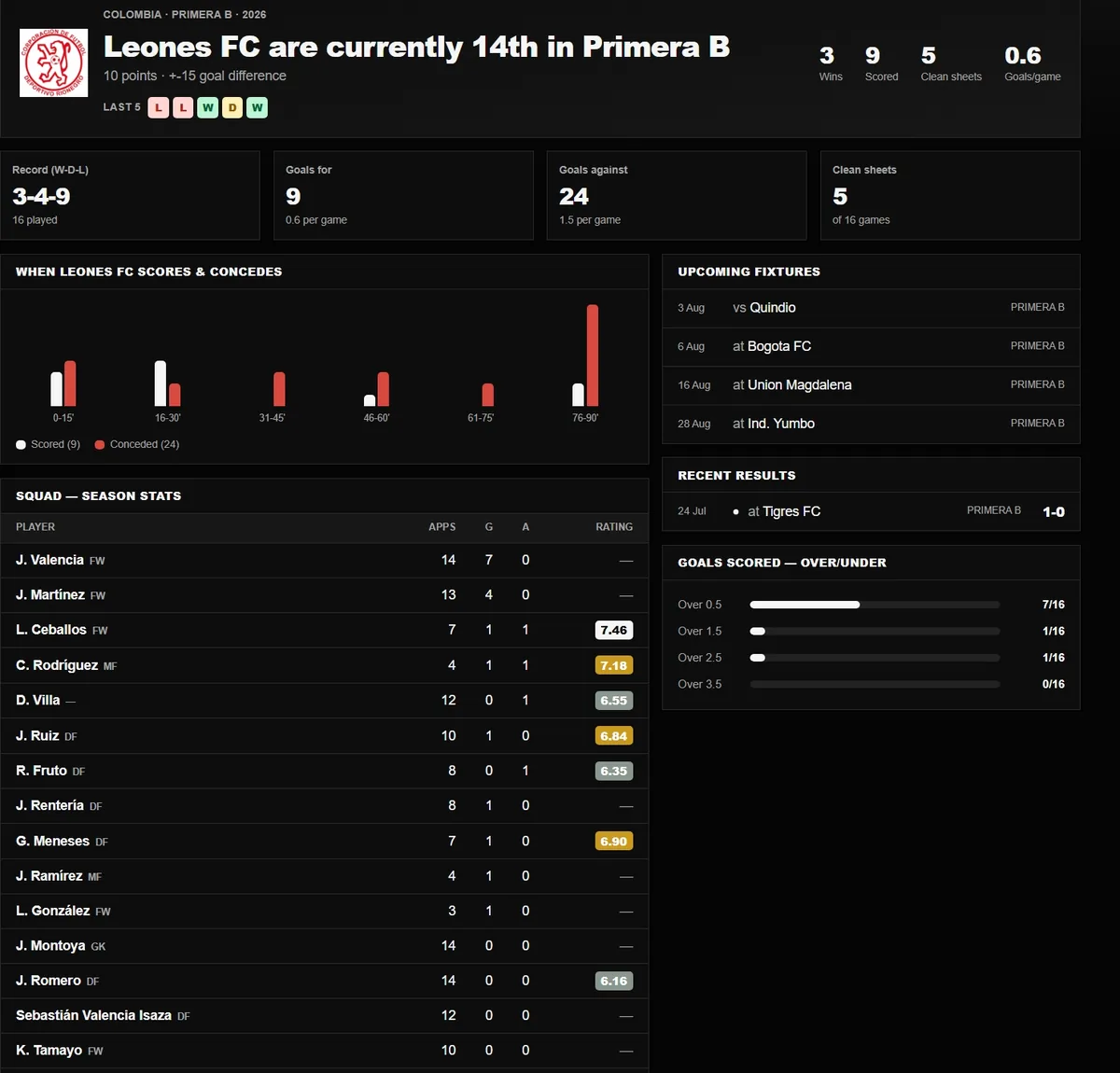
The headline
The top line states the club's position in plain English — Leones FC are currently 14th in Primera B — with points, goal difference, and the last five results as coloured pills. Four figures sit beside it: wins, goals scored, clean sheets, and goals per game.
Those four are a deliberately blunt summary, and they're enough to place a team you've never heard of within a couple of seconds. A side on 0.6 goals a game is telling you something about every goals market it appears in for the rest of the season.
The record tiles
Below that, four tiles expand the same picture: record (W-D-L) with games played, goals for with a per-game average, goals against with its own average, and clean sheets as a share of matches.
The pair to read together is goals for and goals against per game. Their sum is roughly what this team's matches have been producing in total, and comparing that to the over/under line on offer is a five-second sanity check that catches more bad bets than any amount of narrative reasoning.
When the team scores and concedes
A chart splitting the season's goals into fifteen-minute windows, scored in one colour and conceded in the other.
This is the section with the least competition for your attention, because it answers questions averages can't. A team that concedes heavily after the 75th minute is a different bet in-play from one that concedes early, even with identical totals. Sides that fade late leak points from winning positions; sides that start slowly are worth more in a second-half market than a full-match one.
In the example above, nearly a third of the season's goals against arrived in the final fifteen minutes. That's a fitness or game-management story, and it repeats far more often than it doesn't.
Squad — season stats
Every player who has featured, with appearances, goals, assists and average rating, position noted beside the name. Ratings are colour-coded so the standouts and the strugglers separate at a glance.
The column that decides matches is appearances. When one player has a third of the club's goals, that team's entire attacking record is a statement about one person's availability — and that's exactly the thing a season average hides and a team-news line reveals. Check the squad table for concentration, then check who's fit.
Goals scored — over/under
A breakdown of how often the team has gone over 0.5, 1.5, 2.5 and 3.5 goals, shown as a count out of matches played.
This is the team's own goals, not the match total. It's an easy one to misread. "Over 2.5: 1/16" doesn't mean only one of their games had three goals in it — it means they themselves scored three or more once all season. Read as intended it's a direct answer to team-total and BTTS questions: a side that clears 0.5 in seven of sixteen games fails to score more often than not, which is worth considerably more than a goals-per-game average when you're pricing "both teams to score".
Upcoming fixtures and recent results
The next several matches and the last few, each with the competition and — for results — the score and a win/draw/loss dot. Every row links straight to that match page.
Look at the fixtures list for congestion. Three matches in eight days changes selection, and it's visible here before it's visible anywhere else. Recent results with opponents attached also correct the flattery of a form string: five wins against the bottom five is a different season from five wins against the top five.
League table
The full division table with the club highlighted in place, and a link through to the league's schedule. Every other team in it is clickable, so comparing two sides is two clicks.
Formations used and team news
Formations used lists the shapes the manager has picked and how often — a quick read on whether a side is settled or still being worked out, and a clue about a new manager's intentions.
Team news lists current absentees with the reason where it's available. It's the shortest card on the page and frequently the most valuable one. An injury list is the reason a season's statistics can stop describing the team that's about to play.
How to actually use it
The honest use of a team page is checking whether the story you already have is true. Most bets start from a belief — this side is strong at home, that one can't defend, this striker is carrying them. The page takes about a minute to confirm or kill any of those.
Two habits make it pay:
Open both teams, not one. A statistic is only ever meaningful against the opposition's equivalent. A defence conceding 1.5 a game reads as poor until you see what the attack it's facing has actually managed.
Check the sample. Sixteen matches is a season in progress, not a settled truth, and August numbers are close to meaningless. The played count is on the page for exactly this reason.
Start from today's fixtures and click any team, or read what the statistics on a match page tell you about a specific game.
Statistics on this site are informational only. Gamble responsibly, never stake what you can't afford to lose, and if betting stops being fun, BeGambleAware has free, confidential help. 18+