How to make football predictions on Match Terminal
Step by step: sign in, open a match, choose a market, take a bookmaker's price, set your pick public or private, and add the reasoning. How predictions work on Match Terminal.
Match Terminal6 min read
Match Terminal lets you record a football prediction against a real bookmaker price, keep it private or put your name on it, and have it settled automatically once the match finishes. This guide walks through the whole flow, from creating an account to reading your record back a month later.
The short version: sign in, open a match, click the odds you want, choose public or private, save. The rest of this page is the detail behind each of those steps.
Step 1 — Sign in
Predictions are attached to an account, so this is the one thing you have to do first. Hit Sign in in the top-right corner and enter your email address.
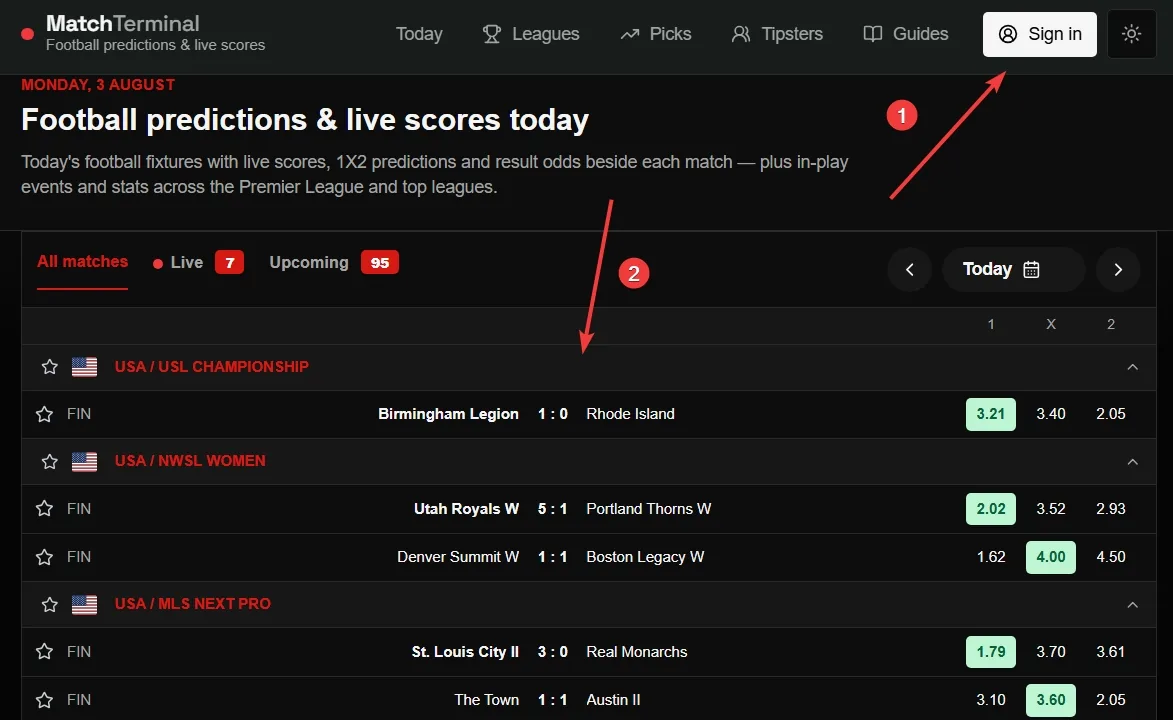
Once you're signed in, find the match you want. The home page lists everything playing today, grouped by competition, with the 1X2 prices beside each fixture. Use the date arrows to move forward or back a day, or the Live and Upcoming tabs to narrow the list. Click any match row to open its page.
One thing worth knowing before you go looking: you can only predict a match that hasn't kicked off yet. Once the clock starts, the pick slip closes. That rule is enforced on the server, not just in the interface, so nobody can backdate a call after seeing how the first half went — which is the entire reason the records on this site mean anything.
Step 2 — Make the prediction
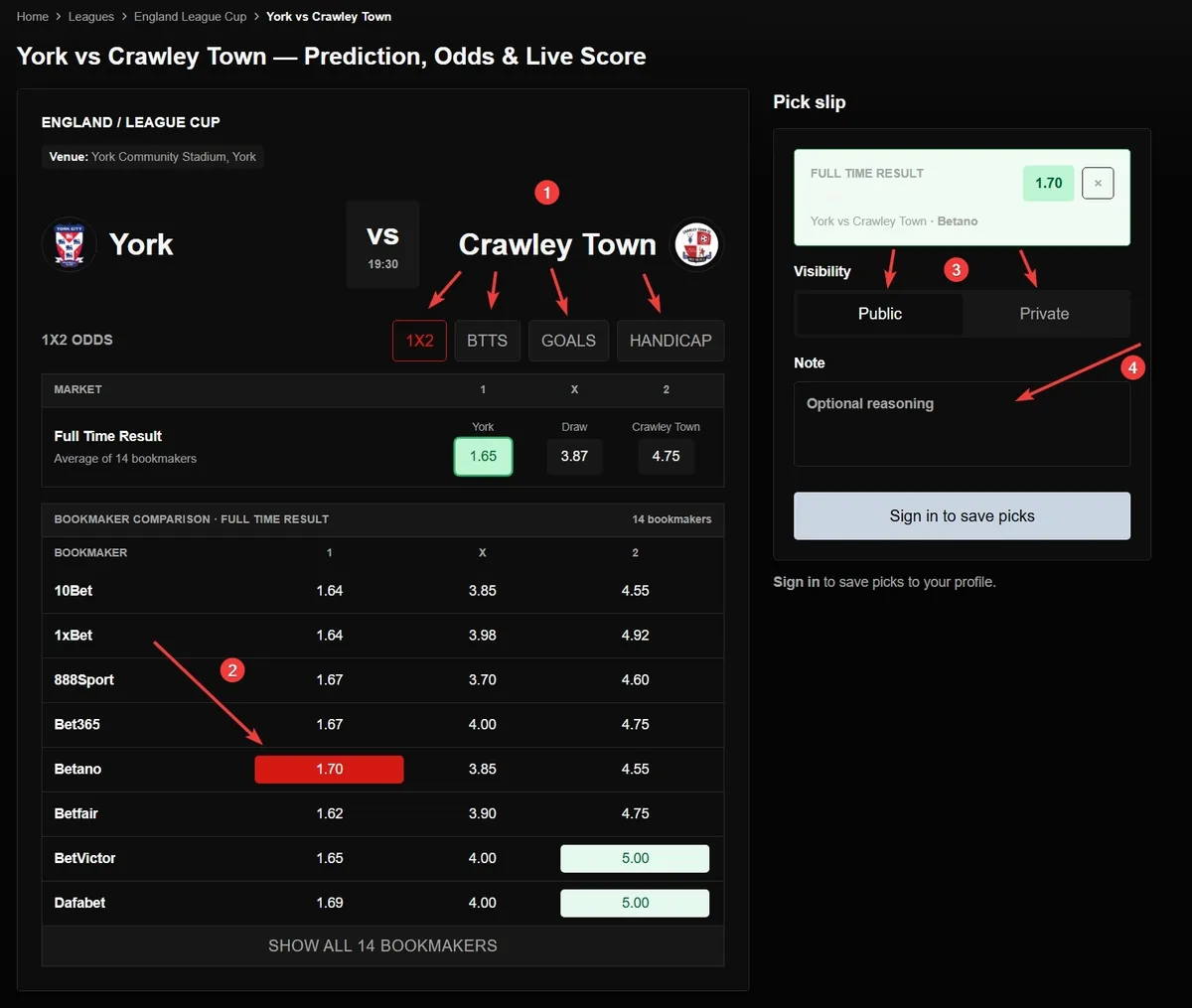
The match page has the odds on the left and the pick slip on the right. Everything below happens in that one screen.
1. Choose a market
Four tabs sit above the odds table, and they cover the four markets most football bets are actually placed in:
| Tab | Market | What you're predicting |
|---|---|---|
| 1X2 | Full time result | Home win, draw, or away win |
| BTTS | Both teams to score | Whether both sides find the net |
| Goals | Total goals | Over or under a goals line |
| Handicap | Asian handicap | The result with a head start applied |
The last two open up further. Goals isn't a single bet — it's a ladder of lines, so you can take over 1.5 in a cagey cup tie or over 3.5 in a shootout, not just the default 2.5. Handicap works the same way, with a row of lines from -2.5 through to +2.5. Pick the tab first, then the line, then the side.
A useful habit: check the headline 1X2 line before you commit, even when you're betting something else. It's the average across every bookmaker that priced the match, and it's the quickest read available on how the market as a whole sees the game.
2. Take a bookmaker's price
Below the odds sits the bookmaker comparison table, and this is the part that separates a recorded prediction from a guess. Click the specific price you want. In the screenshot above, Betano's 1.70 on York is the selection — not the 1.65 average, and not Betfair's 1.62.
The table shows the first handful of books by default. Use Show all bookmakers underneath to expand the full list, which is usually a dozen or more. It's worth doing. On a fairly ordinary 1X2 line the spread between the best and worst price is often several percent, and over a long run of bets that gap is the difference between a winning record and a losing one all by itself.
The price you click is the price your pick is graded at. That's deliberate. A prediction without a number attached can't be judged — "York will win" is either right or wrong, but "York at 1.70" tells you whether it was worth backing, which is the harder and more useful question.
If you have books you actually bet with, set them under Account → bookmakers. Your chosen books get flagged in the comparison table so you can find your own price at a glance, and the headline average is recalculated from just those books rather than the whole market.
3. Public or private
The Visibility toggle decides who sees the pick, and it matters more than it looks.
Public picks appear on your profile and count towards your record on the tipster leaderboard. Other people can follow you and see your calls. If you want a track record — one you can point at, that builds over months and that you can't quietly edit — this is the setting.
Private picks are yours alone. They're settled and scored exactly the same way, and they show up in your own history and stats, but they never appear publicly and never reach the leaderboard.
Both are legitimate uses. Private is the honest way to test a new angle without your record wearing the experiment; public is what makes a record worth showing anyone. What you shouldn't do is keep a pick private because you're unsure and then wish you'd published it — that instinct is exactly how tipsters end up with records that look far better than their actual judgement.
4. Write down why
The Note field is optional. Use it anyway.
A month from now you'll be looking at a list of settled picks, and the ones with no note attached will tell you almost nothing. You'll see that you got a game right without any idea whether you were right for the reason you thought. A single line is enough:
Away side on three days' rest after European travel, home side unbeaten in six at this ground.
That's the sentence that lets you go back and check whether a theory of yours actually works, or whether you just got lucky twice and built a habit on it. Analysing your own results is where most of the improvement comes from, and you can't analyse reasoning you never wrote down.
Then hit Save picks. You can add more than one selection to the slip before saving — take the 1X2 and the BTTS on the same match if you want both. One selection per market, so clicking a different bookmaker's price for the same bet swaps it rather than stacking a second copy.
What happens next
Nothing, until the match finishes. Your pick sits at pending.
Once the final whistle goes, results are graded automatically against the actual score and the pick lands as won, lost, or void (the last for markets that push, like a handicap that lands exactly on the line). You don't settle anything by hand, and you can't — which, again, is the point.
From there you can see your picks on your profile, your strike rate and returns in your account stats, and — if you've been posting publicly — where you sit against everyone else on the leaderboard. The interesting number there isn't strike rate. A tipster hitting 70% on odds-on favourites can easily be losing money, while 40% at the right prices is a serious record. Look at both together.
A few habits worth forming
Predict before the odds move, not after. Prices drift as money arrives and as team news lands. A pick taken on Friday for a Sunday game is a genuine forecast; one taken twenty minutes before kickoff is partly just reading the market. Both are allowed here. Only one of them is really yours.
Don't chase volume. There are ninety-plus matches on this site on an ordinary day and you will not have an opinion worth recording about most of them. A record built on six considered picks a week is more useful — and more honest — than one built on sixty.
Take the best price you can find. It costs nothing to expand the bookmaker table, and it's the only edge on this page that requires no football knowledge whatsoever.
Go back and read your notes. Once a month, filter your settled picks and look for the pattern. Most people find one: a league they read well, a market they're consistently wrong in, a bias towards backing the favourite when the price has already gone. That's the whole return on writing them.
Ready to start? Open today's fixtures, or browse the picks other people have already posted on today's board.
Predictions on this site are informational only. Gamble responsibly, never stake what you can't afford to lose, and if betting stops being fun, BeGambleAware has free, confidential help. 18+